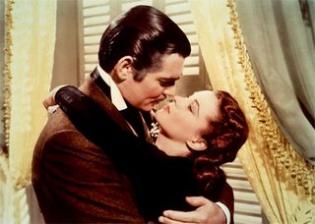
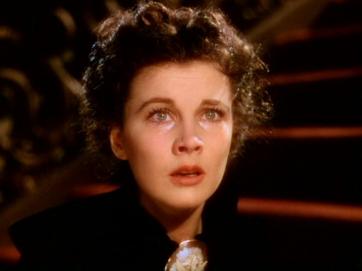
Gone With The Wind - Gone with the Wind, Victor Fleming (1939)  In Georgia, in 1861, Scarlett O'Hara is a proud and willful young woman of high society Southern. Courted by all the good parties in the country, she only has eyes for Ashley Wilkes, despite his engagement with his sweet and shy cousin, Melanie Hamilton. But Scarlett is determined to make him change his mind, but upon receipt of the Twelve Oaks is the cynical Rhett Butler she attracts the attention ... Gone with the Wind
 , most commercially successful of all time (in constant dollars the Titanic
Avatar and Cameron are far from account) is a triumph on many points for its participants. This is a victory studio system whose rigor, organization and contribute to the flair of other notable successes in this particular year 1939 (and to stay at MGM) The Wizard of Oz
images also rooted in the collective unconscious that
Gone with the Wind. is also the consecration of Vivien Leigh, talented and tenacious young English woman who emerge victorious most of the cast played in the history of cinema (Pauline Goddard, Lana Turner, Katharine Hepburn, Bette Davis even auditioned for the coveted role Scarlett) all young American readers of the bestseller by Margaret Mitchell Scarlett O'Hara in dreaming. The Rhett Butler dreamed up by those same readers, Clark Gable reluctantly assume the role as the pressure is great but the star, there will win his spurs as Hollywood legend.

Yet
Gone with the Wind is primarily the triumph of him who commanded the project from start to finish with the authority and the tyranny of a general, producer David O. Selznick. This long-term success is the symbol of the revenge he has always wanted to take on Hollywood. Son of Lewis J. distributor Selznick, who cultivated his taste for very young opulence, he started very young in the movie business as an apprentice for his father whom he must succeed. Everything falls apart when it went bankrupt and the young David vows to polish the name Selznick in Hollywood. Very talented, he became one of the producers missed the middle through MGM (where he started as an apprentice), Paramount and RKO, producing for the last of the great classics like King Kong
. This does however not enough for him and in 1936 he left MGM to form his own production company Selznick International Pictures and took the opportunity to add the famous O giving the prestige required to his surname.

be imagined in the first productions of the studio features such marked productions O. Selznick, for better or for worse: an attraction for the prestigious literary adaptation, romance and an exacerbated taste for pomp and luxury at all times. The film touches the symbol O. Selznick is
Gone with the Wind , a project that just missed him escape. While the book by Margaret Mitchell is not yet published, an assistant in bed trials and subjugated, encourages the mogul to buy the rights. Few believe it will the insistence its used for O. Selznick yield to reason because once published, the book becomes a real social phenomenon. He then undertakes a race against the clock to find the funds (Selznick finally will partner to MGM for the budget) and the casting perfect. Indeed, in addition to dropping the gem to Scarlett O. Selznick must pass to be pay by Clark Gable MGM and Olivia de Havilland by Warner in the role of Melanie. The turmoil in the film itself also belong to the legend. Originally the film was jointly prepared by O. Selznick and his friend George Cukor, the first director envisioned. If the sensitivity of female Cukor worked wonders in all exchanges of spines beginning of the film, Selznick quickly finds that it is not the man for the job to communicate the strength of the epic moments provided.

Separation is rough (but should not interfere with their friendship, even while praising Cukor's triumph at the Oscars the following year) and it was the turn of Victor Fleming to take the stage. Great friend of Clark Gable, it makes it much more comfortable and gives the film the momentum he needed by his energy and roughness. Cukor yielded to the caprices of Vivien Leigh who constantly sought to soften Scarlett Fleming bullies mercilessly for it respects the character of the book (and script) for the result is known: an Oscar for best actress. Exhausted, Fleming will leave the ship temporarily, replaced a week by the modest Sam Wood before resuming his place. Wood, however, remain on the production to shoot some footage of a second team of a production that has accumulated delays and overruns. Even if he commits its share of error of judgments, the real driving force behind the project will be David O. Selznick. Passionate demanding and finicky, he constantly interferes in the authority of its directors (but found to talk with Victor Fleming) that flood of memos picky, often sound as ridiculous as the details. Aware of the draft standing there in his life, his energy (parallel, it also produces
Rebecca Hitchcock) galvanizes a team on the verge of collapse. No offense to the French criticism on the definition of the real author of the film is him.

Originally
of Gone with the Wind , there are of course the novel by Margaret Mitchell which will be the only book. Born in Atlanta, is a true child of the South rocked by the memory of an ancestor who lived through the Civil War (legend has it that the book was inspired by a diary found by the writer) and a mother walking often the remains of the fallen glory. True daredevil adventurer, she will challenge her time by being the first women reporters in the South and inject a lot of his fiery personality in that of Scarlett O 'Hara.
Gone with the Wind is thus the story of the grandeur and decadence of the glorious South, wealthy and proud.

The force of history comes from the perspective adopted, namely the product most flamboyant and arrogant born of the country, Scarlett O'Hara. This is also the shadow of war and the indifference of the capricious heroine who opens the film. Two boys are seen from the back court to a girl while maintaining the threat of imminent war. Dolly while the two figures differ to reveal safe and disdainful of her charms Scarlett O 'Hara, who then expressed his deep contempt for the things of war and its suitors amount of maintenance subjects more fun.

The first part shows the South so legendary in the magnificence of a lost paradise, its people proud and confident in the future, his slaves happy in their condition and being treated well. This last point (and even then) wince as the roles may seem caricatures of blacks and the film is on a tightrope between the energetic and engaging interpretation of Hattie McDaniel (the first Oscar for a black actress in the key ) in Mamma and the much more problematic Butterfly McQueen replay the silly servants
Duel in the Sun .

During the long preparation beforehand, Selznick will be wise idea to hire William Cameron Menzies on the film's artistic design. Visual genius, he has much evolved in the English productions of Alexander Korda (The Thief of Baghdad
, the amazing film adapted from HG Wells SF
Worlds future that realizes in 1936 and which was spoke in April on the blog) that later in Hollywood including Selznick therefore
Duel in the Sun . He designs for
Gone with the Wind elaborate drawings, an evocative power and a bombast that anchor the story in a mythological past blazing.

opening connects the visions so fabulous as the sequence where the shadows of Scarlett and her father are taking shape at the foot of a gigantic tree, a traveling back revealing what they behold: the imposing vastness of the area Tara where the servants are busy, bathed in sunshine glowing, announcing already the twilight of this world. The staging inspired by Fleming offers scope to all such moments, backed by the lavish photo of Ernest Haller (who replaced Lee Garms being film) and the unforgettable score by Max Steiner. This is offset by moments up more humane but running on the same idea as this sumptuous ballroom scene where the swagger of young Southerners alternate with the beginning of a love triangle between Rhett Butler, Scarlett and Ashley Wilkes.

After the Civil War began, it was again progressively lost the innocence of Scarlett that will reveal the apocalyptic visions of the conflict. Infirmaries unhealthy saturated mangled screaming in pain, Atlanta fire and sword to the impending defeat, the movie ose moments of unbearable cruelty reinforced by the bias of the monumental. The most striking moment remain the arrival of Scarlett at the station in Atlanta, where a crane movement offered the magnitude of the debacle with the Confederate soldiers wounded in the eye. In that hell may yet rise from the noblest moments, always colored by the ambiguity of intentions Scarlett: the pain of childbirth Melanie heroic flight from Atlanta into chaos and especially the kiss snatched from the Gable heroin loses the ironic distance flown so far for a declaration of love and violent passion.

Return to Tara now ravaged obeys an inverse manner to the opening. Desolation, misery and starvation to meet the opulence of yesteryear. Scarlett now would just aim to make their luster lost his land, the only thing that matters as he finally told his father in other happier times. Fleming reproduces the same camera movement as the beginning with only this time Scarlett guarantor of Southern pride. While his fierce figure stands under a scarlet sky, she screams the whole world that she will never again feel the hunger that the pincers, see the poverty that surrounds him. At any price ...
 Gone with the Wind
 represents the collective unconscious (and we have seen the film or not) the quintessential expression of romantic cinema. Critics of this form of narrative, all that bombast is no unwelcome cliches and sentimentality of any kind. There is indeed a common obedience to the canons fiction classics in
Gone With The Wind, but not the main couple. Ashley Wilkes (Leslie Howard) chimera which runs after love Scarlett represents the fragility, dreamy and poetic personality of classic romantic hero. His wife Melanie (Olivia De Havilland) is benevolence personified, a kindness and unwavering support for his friends and above all unconditional love for her husband and exclusive. We need all the conviction of his two interpreters characters (including Olivia de Havilland beautiful) not falling into the marshmallow harder. A recent film like Cold Mountain
prefer emulate his heroes on the most reassuring Ashley / Melanie that the real couple in hell center of the film Selznick.

Once again, it is in the evolution of Scarlett throughout the film that we must seek the reasons for the romance (s) through the amazing brilliant performances by Vivien Leigh. George Cukor it will initially helped to find the right tone (he advice even after he left the shoot) of this detestable and Scarlett both endearing and Fleming will push its limits in order to explore its real shadows and do not make a conventional romantic heroine. So starting over on a whim to have been abandoned for another that clings to Scarlett pale Ashley Wilkes. He is a man who, despite low transparent and genuine attraction regrowth for fear of their different characters to marry his cousin in the gently more similar to hers.

Later, he will maintain the illusions of Scarlett for lack of courage by not telling him that he is really in love with Melanie. While avoidance and hesitation, it is the exact opposite of the more determined Rhett Butler. Once he saw Scarlett at the grand ball scene southerner, he literally undresses gaze and the first exchange between them (after she was gently pushed once by Ashley) will be worthy of the screwball comedy the most removed.

Where a son Ashley is a good family of transparent, Butler behind a turbulent past as a racer and unsavory player. Clark Gable gives all his masculinity, his poise and relaxation at this charming bad boy. He recognized immediately in the personality of volcanic Scarlett a woman of her caliber. This supported virility, strength of character that make it the ideal man for Scarlett, whether in the set pieces (the whole episode of the flight from Atlanta) where he seems indestructible, or so the underlying fact that it is the only man not manipulated by the film's heroine.
Beyond the historical aspect, or even romantic,
Gone With The Wind is a great film about survival. Survival of a lifestyle, a part of an idealized past. That's what Scarlett clings through Ashley Wilkes or more interested in her second husband and finally Rhett Butler. To preserve his memory, no villainy will be too many, the most despicable being to marry the wealthy fiance of her sister. She finally yield to Rhett for his wealth (and its promise to renovate Tara) without realizing that it is the only man with whom she was never happy.

Heroes and pass the film to miss each other, the intensity of feelings for each other is never like the same time. This occurs when the most daring sequence of the movie where Scarlett finally discovers his feelings for Rhett. Tired of being again separated from his wife by the memory of Ashley, he grabs under the influence of drink to their room for what seems nothing short of a marital rape. Yet surprise when the following sequence where Scarlett wakes radiant, happy and finally in love with "her" man.

The film so far to balance narrative gives a little too perfect in its last third to the spate of adventures (several tragic deaths occur at a time too short) to widen the gap between Rhett and Scarlett has an eye-opener too late. The supposed archetype of the romantic film therefore ends in a magisterial rebuke to her heroine through this bitter exchange.
-
Scarlett: "Rhett, Rhett ... Rhett, if you go, Where Shall I Go?" What Shall I Do? "
-
Rhett: "Frankly, my dear, I do not give a damn.
is in this lack of compromise that the film finds its essence yet romantic. By raising for his monumental proportions by the framework consequences of mutual incomprehension, a failed romance, the film speaks to everyone. To those maintaining the resentment of the man who brought so much suffering to those who live in the memory of the loved and lost especially those living in hope never to regain an off day ...

It is on this note of hope that ends the film by combining this ode to the South to the power of narrative fiction. By Tara is the cradle of its strength and its origins that Scarlett will perhaps one day be able to find Rhett. An open ended fantasy and * among the finest in film history.
After all ... Tomorrow is another day. * The inevitable result will
also very late with the novel
Scarlett by Alexandra Ripley Scarlett and adatpation mediocre soap opera in which Joanne Whalley and Timothy Dalton reprising their roles mythical.
Available on DVD Zone 2 French and recently reissued in a sumptuous edition for the 70 years of film .

 The film questions the discrepancy that can cause intellectual awakening, the birth of a passion with a more mundane surroundings. Sandrine Bonnaire and really carried away by something for the first time in his life finds it hard to join this craze with his family and his job more ordinary. The other characters, very well written (including an excellent Renaud Francis in the role of husband) also expressed their incomprehension at her, and this opposition gives the film a very successful social dimension. Without knowing it, by discovering a passion she has real talent, Helen rises well above the fray at his expense, and is finally "different" and "offset" against his associates every day. Thus the strategic and military failures (most used when approaching this game the movies) is completely erased in favor of the more social and feminist, including the emphasis on the figure of the Queen (the most powerful piece of gaming).
  Sandrine Bonnaire delivers a stunning performance, her face lights up at the start so detached as and as the film progresses and she asserts in her art. She who has the habit of seeing in very dramatic roles (though there are exceptions of course like the beautiful Miss of Lioret that made it a romantic heroine) is radiant in this more positive note. Caroline Bottaro drives the point by multiplying the playful visual tricks to show the invasion of failures in his mind. Among the best ideas, our heroine launched in the imaginary parts with crumbs on a checkered tablecloth during dinner at a restaurant, or on a checkered floor tiles for a tile that same household taking a uniform color when she starts to doubt .
  As in any movie "sport", a mentor is needed, here brilliantly portrayed by Kevin Kline Dr. gruff and lonely. Once again, Caroline Bottaro discusses their relationship with accuracy, avoiding the expected love story (without neglecting the mutual attraction experienced watermark) and the easy pathos through Kline's disease. The staging of chess is very successful. They aroused the interest of insiders and others (who will find hard to get started after the film), alternating maneuvers on the plates with the reactions of players, strained or amused. It is so taken by the party as much by the content of the game itself than the content of suspense and drama of the situation (going t make it?).
  The party which concludes the film pushes the parallel with the pattern of sports movie using all the tricks possible to strengthen the narrative tension. The performance of Helen is an internal dialogue and voice-overs, the use of flashbacks and a nice idea of telepathy between Kevin Kline and Sandrine Bonnaire. An amazing surprise is the casting with the discreet presence of Jennifer Beals in a trigger and it is difficult not to draw a parallel with his role as worship Flashdance where she also went out of his condition by his gift for dance. Maybe it is totally unintentional coincidence but it offers additional depth to the key feminist film. One of the beautiful French Recent successes Caroline Bottaro which has still not responded. Hopefully soon!